Client panel tour: menu, servers and live alerts
A tour of the SolumeCore client panel: Solume and Minimal styles, the menu and More, server tabs by type, guided tours, bug reports and live alerts.
The SolumeCore client panel is where you run everything you buy: your servers, invoices, tickets, domains, notifications and account settings. It lives at dashboard.solumecore.com. The layout is always the same, wherever you are: a side menu that says where you are in your account, a top bar with search, credit, help and the notification bell, and, inside a server, a header and a short row of tabs that say where you are in that server.
This tour goes through each part with the exact English labels: the two panel styles, the side menu and its More entry, the top bar, how a server is organized for each type of service, the guided tours, reporting a bug, the notification bell and the live alerts. If you have not placed an order yet, read create an account and place your first order first.
Two styles: Solume and Minimal
The panel comes in two styles. You pick one the first time you sign in, in a short Make the panel yours window, and you can change it any time under Account › Appearance.
- Solume: the full look, with depth, a soft glow on hover and richer cards.
- Minimal: flat and calm, with a lighter menu, the server list as a compact list, no glow and fewer borders.
- Reduce effects: turns off animations and glows in either style. In the first-run window it appears as Solume · Optimized.
The style and Reduce effects are saved to your account, so they follow you to any device. The theme (light, dark or system) and the Server view (Cards or List) are remembered in each browser. Every screen works the same in both styles; only the look changes. For the step-by-step, see change the panel style and effects.
The side menu
The menu is the same on every page. The entries you use most are always visible, and the rest live under More at the bottom.

| Group | Always visible | Under More |
|---|---|---|
| (top) | Home | |
| Servers | Servers, Games, Apps & bots, VPS & VDS, Web hosting | Bring from another host, Firewall |
| Domains | Domains | |
| Billing | Invoices & payments, Referrals | Guarantees |
| Support | Tickets, Help center | Service status, Security cases |
| Account | Profile & security, Notifications | Account activity, Integrations, API & webhooks, AI & copilot, Discord bot |
- Games, Apps & bots, VPS & VDS and Web hosting show up only if you own that type of service. Servers always lists all of them.
- Guarantees appears only when guarantee features are turned on for the platform, so most accounts will not see it.
- Bring from another host opens the migration assistant, to move a server or site you already have elsewhere. Firewall is where you manage the DDoS protection rules for your services.
- More opens by itself when you are on one of its pages. Everything under it can also be found with
Ctrl+K. - Help center opens the public help articles, and the New server button takes you to the plans on the website.
On a phone, a bottom bar gives you Home, Servers, Billing, Support and More, which opens the rest of the menu.
The top bar
From left to right you find:
- Your servers: a switcher to jump straight to any server. Type to filter. Servers that are being set up, suspended, paused or in error show a status label.
- Search or run a command...: the command palette. Open it with
Ctrl+K(Cmd+Kon Mac) or/. It finds servers, pages, invoices to pay and open tickets, and runs quick actions such as restarting a server, opening its console, files or backups, paying an invoice, or switching between light and dark mode. - Credit: your account credit. You top it up from Billing.
- Report a bug: the bug icon. It opens a short form to tell the team about something that does not work. See Report a bug below.
- Cart: only if the cart is enabled on the platform.
- Help (
?): guides that match the page you are on, the keyboard shortcuts and the guided tours. - Notifications: the bell, explained below.
- Your account menu (the circle with your initial): Profile & security, Notifications, Report a bug, the theme (Light, Dark or Match my device), Style and effects..., which opens Account › Appearance, the language, Back to the website and Sign out.
Keyboard shortcuts
Press ? anywhere to see them. The main ones: Ctrl+K or / for search, ? for help, g followed by a letter to jump (g i Home, g s Servers, g f Billing, g t Tickets, g d Domains, g c your account), and the backtick key to open or close the live console inside a server.
Home and the server list
Home says in one line whether everything is running normally and shows Your servers (star the ones you use most and drag to reorder them), what you owe, your open tickets and a Getting started card.
Servers lists everything you own, with tabs by type, search, a Status filter, Sort and the Cards and Table views (the Minimal style starts with the compact one). Each server shows its live state, address, location and renewal date, with Start, Restart and Stop at hand. Servers other people shared with you are marked Shared with you.
Inside a server
Every server is organized the same way, whatever its type.
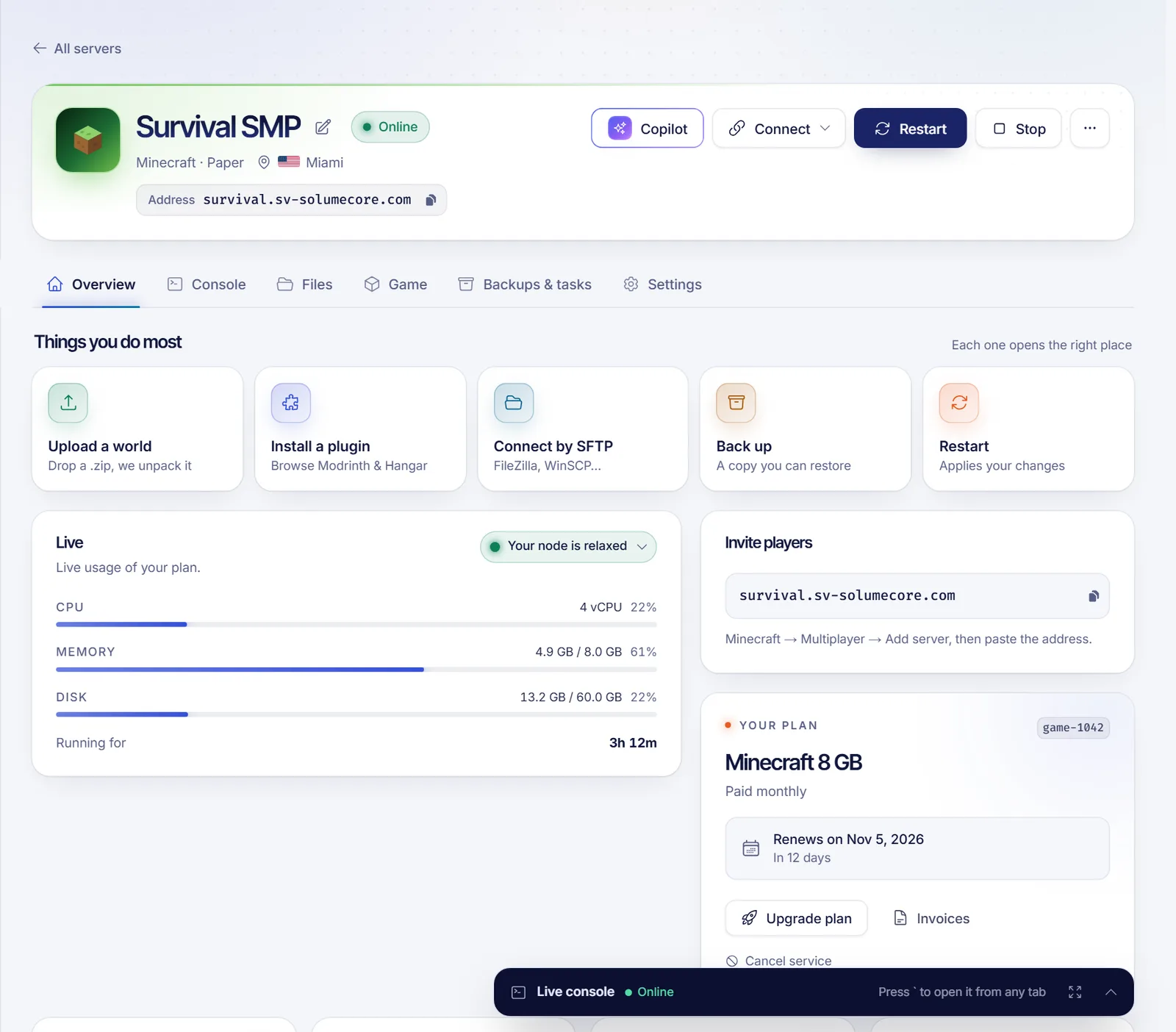
The header shows the name, status, type, location and the Address chip, which you can copy. On the right:
- Connect opens a small panel right under the button (a sheet from the bottom on a phone) with everything you need to reach the server: the address to play and the SFTP details for a game server or app, the SSH command, IP and password for a VPS or VDS, and cPanel, FTP and mail settings for web hosting.
- Copilot, the AI assistant (not on web hosting), and the power buttons: Start, Restart, Stop and a menu with more options such as forcing a stop.
The tabs are few and named after what you want to do. Inside a tab, the parts appear as cards or as a short row of pills:
| Type | Tabs and what is inside |
|---|---|
| Game server | Overview · Console (Live console, Performance) · Files (Files, Databases, Import from another host) · Game (World, Plugins & mods, Players & community, Add-ons) · Backups & tasks (Backups, Restore an area, Scheduled tasks) · Settings |
| App or bot | Overview · Console (Live console, Logs & health) · Code (Deploy, Variables, Packages) · Files (Files, Databases, Import from another host) · Backups & tasks (Backups, Scheduled tasks) · Settings |
| VPS and VDS | Overview (At a glance, Performance) · Console (Terminal (SSH), Screen (VNC)) · Network (IPs, reverse DNS, traffic) · Backups (Backups, Snapshots, Rescue mode) · Settings |
| Web hosting | Overview · Files (Files, Databases, WordPress) · Domain & DNS (Connection, DNS zone, Domains & subdomains) · Email (Mailboxes, Forwarders, Deliverability, Mail apps) · Backups · Settings |
Tabs vary with the game, the plan and your permissions: someone you invited only sees what they are allowed to open. In games other than Minecraft, World is called Game settings and only shows that game's settings. Links you saved before still work: every section keeps its address, it just lives in a new tab.
A few things work the same way across types:
- Overview starts with cards for the things you do most (for example Upload a world, Install a plugin, Connect by SFTP, Back up and Restart on a game server). Each one opens the exact place.
- Settings lists its groups in a menu on the right: General (the basics, plus version, startup or operating system depending on the type), Network & domain (games and apps: address, subdomain, ports and your own domain), Access (the people you invited) and Advanced (test copy, sub-servers, usage and history, depending on the type). On a VPS the network has its own Network tab instead.
- Files on a game server or app starts with a strip to connect from your computer: the host, port and user are in view, and Connect by SFTP opens the password and the button to open FileZilla or WinSCP. See connect by SFTP from the Files tab. Web hosting shows its FTP details in the FTP access card of Files instead.
- Live console: on game servers, apps and VPS, a folded bar at the bottom of every tab except Console shows the server state. Expand it to watch the output and type commands without leaving the tab you are on, or press the backtick key from anywhere;
Escfolds it again. Web hosting has no console.
On a phone, the server tabs move to a bar at the bottom: the first four tabs plus More, which holds the other tabs, Connect, Copilot, the power actions and All servers. For more detail on games, see the game server panel guide.
Guided tours
Two short guided tours point at each part of the screen, one step at a time:
- Panel tour: about a minute through the menu, search, billing, support, notifications, help, Report a bug, your account and More.
- Server tour: inside a server, through the header, the tabs, Connect, Files and SFTP, the live console and Settings.
Start them from Help (?), from Ctrl+K, or from Account › Appearance (Panel tour). The first time you enter a server, a small banner also offers the server tour once. Move with the arrow keys and leave with Esc at any time. See take the guided panel tour.
Report a bug
If something in the panel or one of your services does not work as it should, use Report a bug in the top bar or in the account menu: you describe what happens, can attach screenshots and follow the team's answer under My reports. If it turns out to be a real bug, there may be a reward on your account balance; the team decides case by case. More in report a bug and rewards.
The notification bell
The bell sits in the top bar with a red counter for unread items (shown as 9+ above nine). It refreshes by itself every few seconds, so a support reply shows up without reloading.
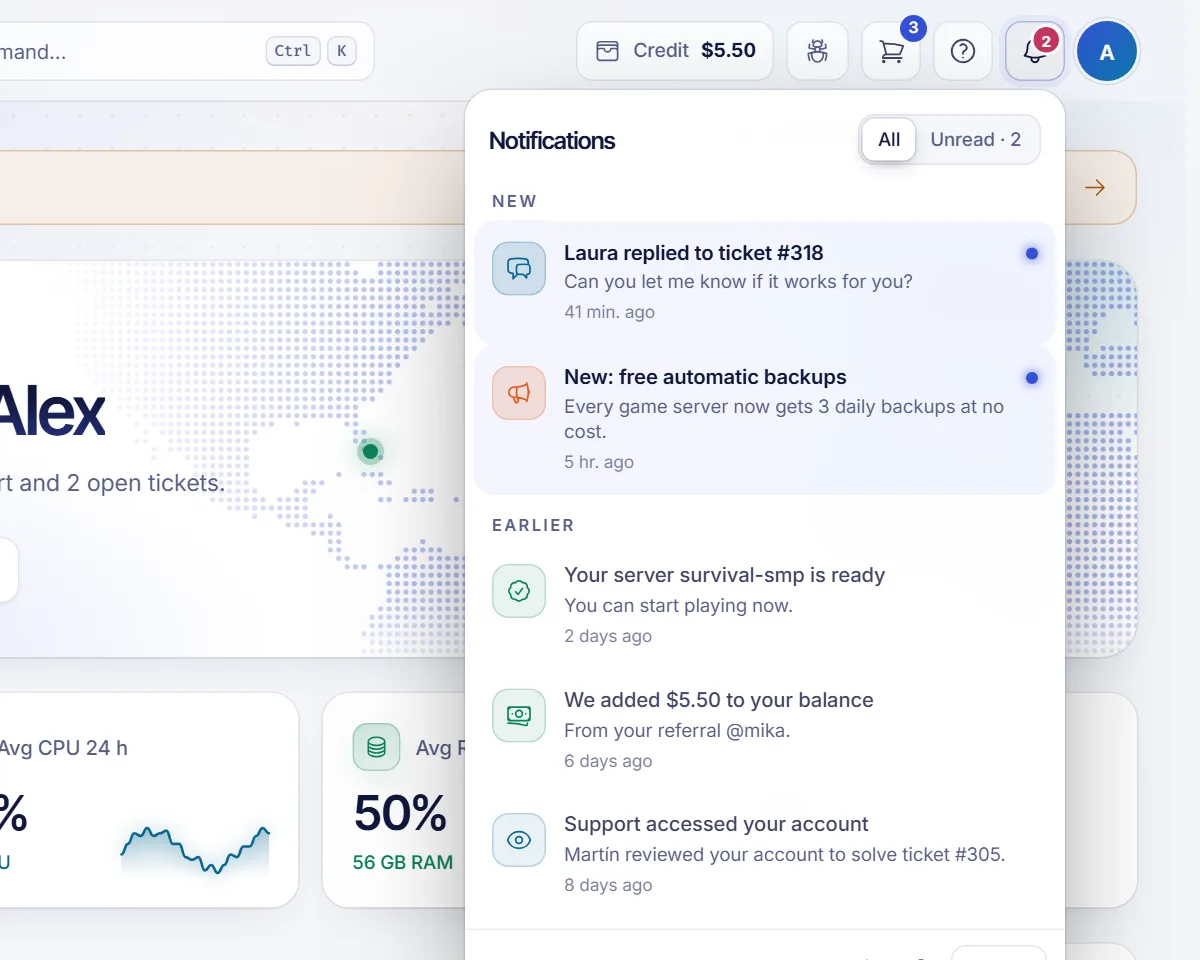
- Switch between All and Unread. Items are grouped as New and Earlier.
- Click an item to mark it read and open the related page.
- Mark all as read clears the counter.
- The speaker icon mutes or unmutes alert sounds for this browser, the gear opens Notification settings, and See all opens the full page.
The full Notifications page has three tabs: Inbox (search, filter and delete), Alerts (rules that watch your servers, such as Server down, High CPU, High RAM, Disk almost full, Invoice due soon and HTTPS certificate expiring), and What and where. In the last one you choose, per kind of notice (Alerts, Servers, Backups, Billing, Security, Support, Referrals, Announcements, Other), which channels deliver it: Panel (always on), Email, Discord, and Telegram when it is available.
Live alerts: sound and desktop notifications
Live alerts let the panel tell you something new arrived even when you are in another window. You set them up under Notifications, tab What and where, in the Live alerts card. They are saved only in this browser, so each computer or phone has its own settings.
| Setting | What it does | Default |
|---|---|---|
| Play a sound | A short tone when a notification arrives. Choose a Volume and a Tone: Soft, Bright or Bell. Tickets get a rising melody and urgent alerts a more insistent one | On |
| Desktop notifications | A pop-up from your browser, only while the tab is in the background or minimized. Clicking it takes you to the notification | Off |
| What to alert | Tickets and messages, Payments, Purchases and services, Urgent alerts, Everything else. Only the ticked types make a sound or a pop-up; everything still shows in the bell | All on except Everything else |
You can test both with Test sound, Test urgent alert and Send a test notification. If several notifications arrive together, you hear one sound and see one summary, such as "5 new notifications", instead of five pop-ups.
Important: The browser decides whether sounds and pop-ups are allowed. If you see "Your browser is blocking alert sounds", click anywhere on the page and press Enable sound. For desktop notifications, allow Notifications for the site (lock icon next to the address bar) and reload; on Windows, also check that your browser is allowed in system notifications and that Focus assist is not hiding them.
Related documents
- What is SolumeCore?
- Create an account and place your first order
- Game server panel
- Change the panel style and effects
- Take the guided panel tour
- Help center
FAQ
Where did Firewall, API & webhooks and Integrations go?
They are under More, at the bottom of the side menu. Click More to open it, or press Ctrl+K and type the name of the page.
What is the difference between the Solume and Minimal styles?
Only the look. Solume has depth, glow and richer cards; Minimal is flat, lighter and shows the server list as a compact list. Every option is in the same place in both. Change it under Account › Appearance.
Where is the console now?
In the Console tab, and folded at the bottom of every other tab as Live console on game servers, apps and VPS. Press the backtick key to open it from anywhere.
Where are my server's settings, like the network or the people I invited?
In the Settings tab, grouped in the menu on the right: General, Network & domain, Access and Advanced. On a VPS, the network has its own Network tab.
Why am I not getting desktop notifications?
Check that you enabled Desktop notifications in the Live alerts card, that your browser allows notifications for the site, and that the tab is in the background, because the pop-up only appears then. Use Send a test notification to check.